
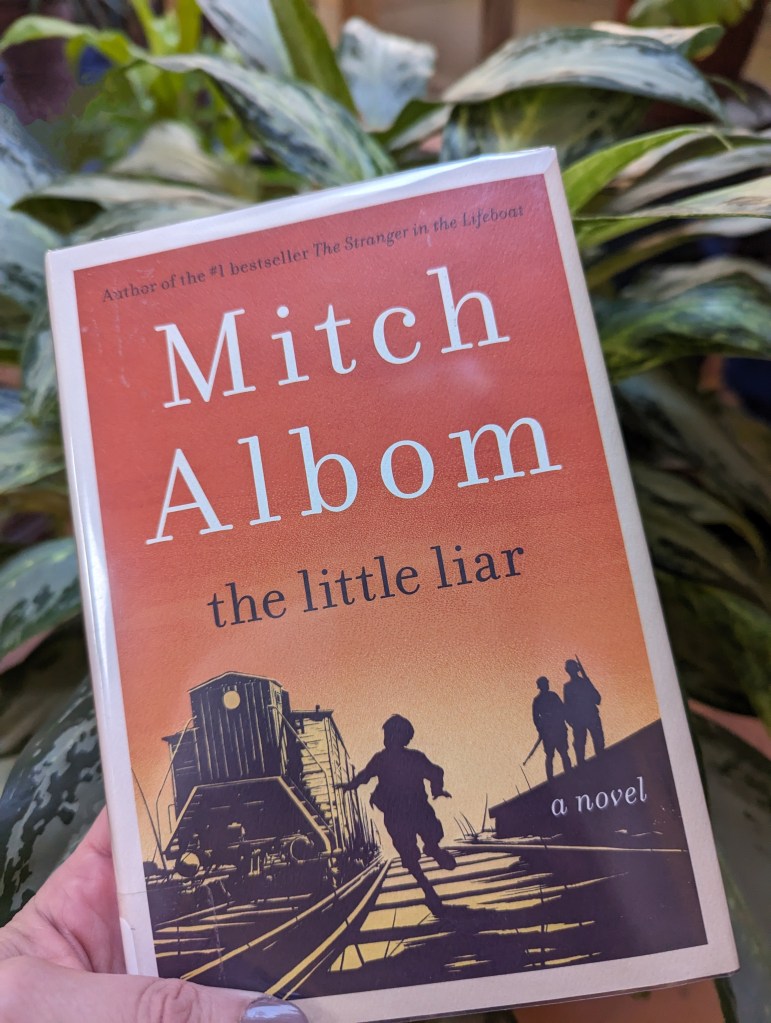
I just finished this beautiful book by Mitch Albom. I’ve only read two of his other books: Tuesdays with Morrie and The Five People You Meet in heaven. And it’s been a long time since I have read those. This book was unique in that the narrator is “The Truth”. What is the truth and what is a lie? What is the price we pay for telling one or the other? These are the themes of the book. Interestingly, I am also reading the last book that one of my favorite religious authors wrote: Wholehearted Faith by Rachel Held Evans( I will likely post more about her and her books later). In the current chapter The Liberation of the Know-It-All, she discusses absolute truth. ”It’s not that I don’t believe absolute truth exists, but if it does, it would take the mind of God to know it in its fullness. I don’t think that absolute truth is sitting there in plain sight, waiting to be noticed. If it exists, I imagine it to be more like the wind, gently alerting us to its presence.” In The Little Liar, the Truth says : “Truth is Universal. You often hear that expression. Nonsense. Were I truly universal, there would be no disagreement over right and wrong, who deserves what, or what happiness means. But there are certain truths that are experienced universally, and one of them is loss…. Yes. Loss is universal. Everyone is their lifetime will know it.”
The Little Liar is a book about 4 characters and what happens as a consequence of spreading what one character thinks is the truth, but is really a lite. In an interview for the Jewish News Syndicate, Mitch Albom sad he wanted to make a point about how the truth was abused during the Holocaust and about the price we pay for abusing the truth. I’ve read a lot of books about the Holocaust, both fiction and non-fiction but it is always surprising to read an account from a perspective I hadn’t heard before. I did know about the experiences of Jews in Greece which was the focus of this book. In 2018 my husband and I were in Budapest at the end of a Danube River cruise and we walked down the street and decided to take a tour of the Hungarian Jewish Museum and Archives. There I learned about the Arrow Cross and what happened on the banks of the river as depicted in one part of this book. This was a part of history that I did not know prior. There is still so much to learn. I highly recommend this book. It is hard to put down and does not take long to read.

 waynegalreads
Leave a comment